Three questions, not one
Decoration decisions go wrong when they are made on appearance alone. A method that looks right in a sample can be the wrong choice because of the fabric it will run on, or because the quantity makes it uneconomic.
Three questions settle it in almost every case: what fabric is it going on, how many pieces are there, and what does the artwork actually contain.
Screen printing
Screen printing pushes ink through a mesh, one screen per colour. Setup cost therefore rises with colour count and is spread across the run, which makes it the cheapest method at volume and an expensive one for fifty pieces.
It produces the most opaque and durable result on cotton, which is why it remains the default for tee shirt and sweatshirt graphics. It is the wrong choice for photographic artwork, and it loses fine detail on textured surfaces such as pique and heavy fleece.
- Best for: solid colour artwork on cotton at volume
- Economics: setup per colour, low unit cost at quantity
- Watch for: dye migration on dark polyester, detail loss on textured fabric
DTG printing
DTG prints ink directly into a finished garment, the way an inkjet printer prints onto paper. There are no screens, so colour count costs nothing and a single piece is viable.
It works best on cotton rich fabric and requires pretreatment on dark garments. Its unit cost does not fall much with quantity, so above a few hundred pieces screen printing usually wins on cost.
- Best for: photographic or multi colour artwork at low quantity on cotton
- Economics: no setup, flat unit cost regardless of volume
- Watch for: limited performance on polyester rich fabric
DTF printing
DTF prints artwork onto a film that is then heat applied. Because the ink never has to bond directly with the fibre, it works across a much wider fabric range than DTG, including polyester, blends and coated fabrics.
The trade off is that the print sits on the surface rather than in the fabric, so handfeel differs and large solid areas reduce breathability. For mixed fabric programmes it is often the only method that gives one consistent result across every item.
- Best for: mixed fabric programmes and detailed artwork at low to mid quantity
- Economics: no setup, flat unit cost
- Watch for: surface handfeel, breathability on large solid coverage
Sublimation
Sublimation turns dye into gas under heat so it bonds into polyester fibre. The result has no handfeel and cannot crack or peel, because there is nothing sitting on the surface to crack.
It has two hard constraints. It only works on polyester rich fabric, and it cannot print white, since it adds colour rather than laying down opaque ink. Any white in a design is the base fabric showing through.
- Best for: full coverage graphics and per piece personalisation on polyester
- Economics: viable at low quantity, since artwork is applied per piece
- Watch for: no white printing, no use on cotton
Embroidery
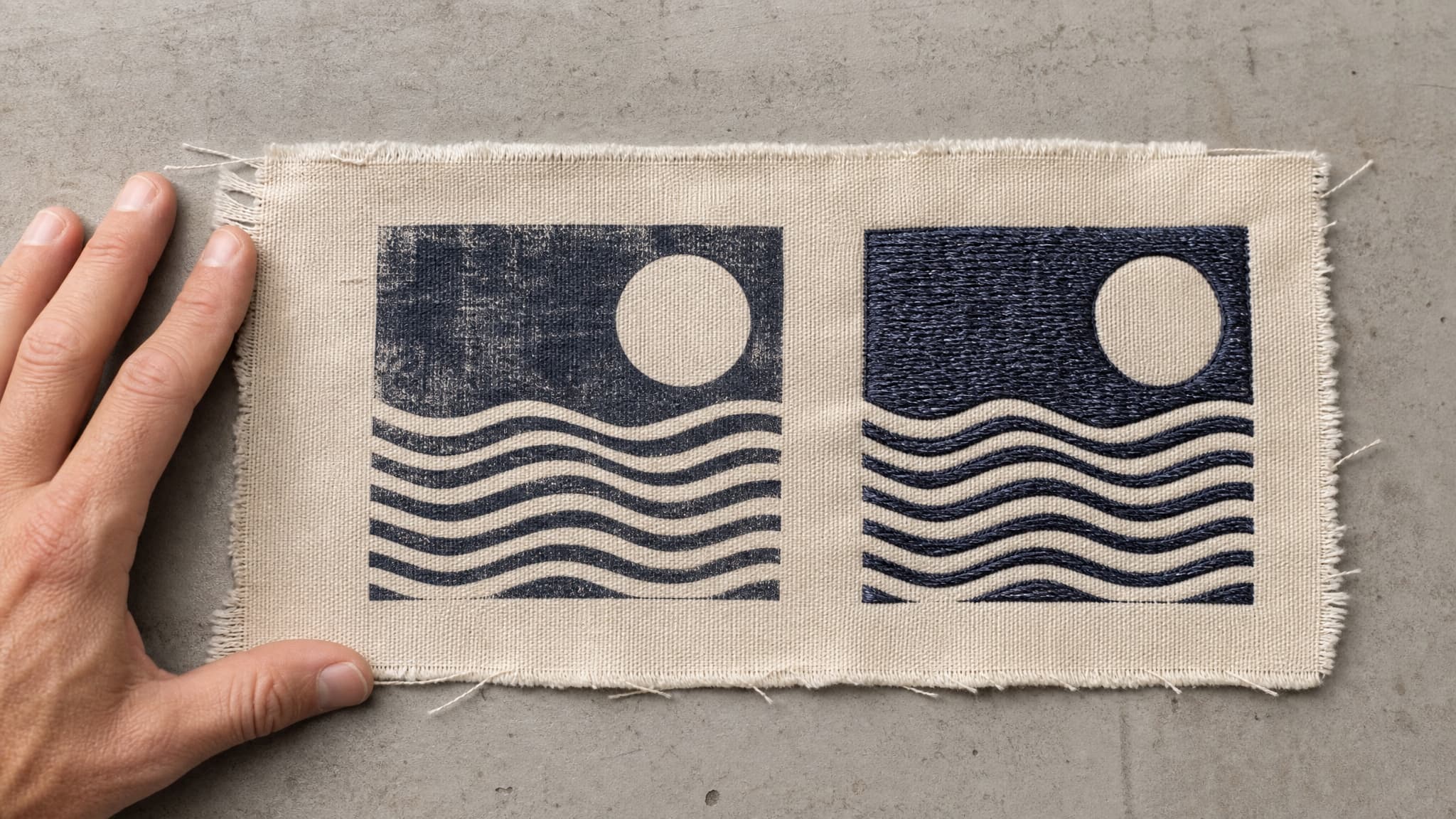
Embroidery builds a logo from thread. It outlasts every printed method, which is why uniform programmes rely on it almost exclusively.
Its limits are dimensional. Lettering below roughly four millimetres does not reproduce reliably, gradients cannot be stitched, and dense designs stiffen lightweight fabric. Artwork that works in print frequently has to be redrawn for embroidery.
- Best for: logos and durable branding on uniforms, polos and headwear
- Economics: digitising is a one time cost, unit cost driven by stitch count
- Watch for: small text, gradients, distortion on lightweight fabric
Mixing methods in one programme
Most real programmes end up using more than one method. A campaign covering tee shirts, caps and tote bags might use screen printing on cotton tees, embroidery on caps and DTF on a blended jacket, all reproducing the same logo.
That is the correct approach rather than a compromise. Matching the method to each fabric produces a more consistent visual result than forcing one method across every item.