
Loading page content
Loading page content
Decoration
Direct to garment inkjet printing. Suits photographic artwork and low quantities without screen setup.
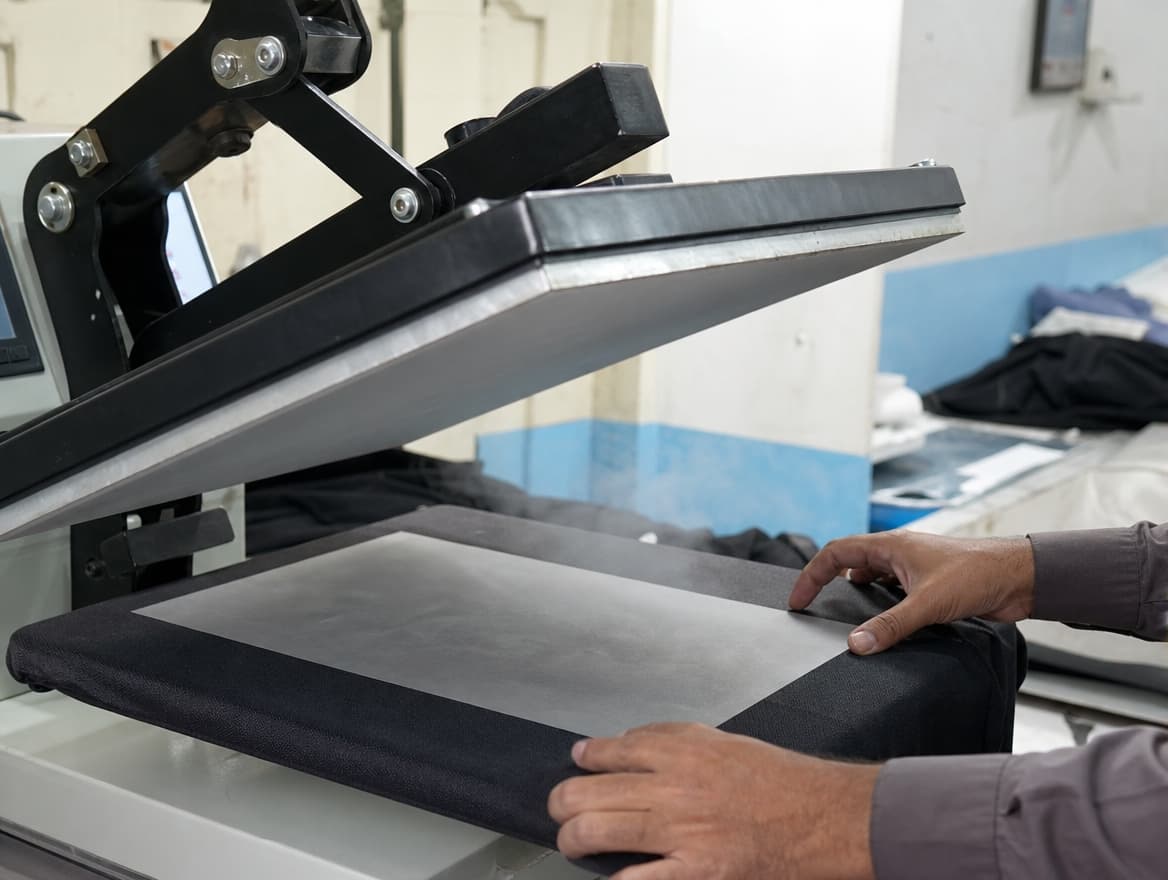
DTG prints ink directly into the fabric of a finished garment, in the way an inkjet printer prints onto paper. There are no screens, so there is no setup cost per colour and no minimum driven by colour count.
The trade off is fabric dependence and unit economics. It performs best on cotton rich fabric, needs pretreatment on dark garments, and its per piece cost does not fall away with quantity in the way screen printing does.
Process
Each stage exists to resolve one question. Skipping a stage moves risk further down the line rather than removing it.
Files are prepared at print resolution with colour profiles applied.
Dark garments are pretreated so white underbase ink holds on the surface.
The garment is printed directly.
Ink is cured to fix it into the fibre.
Suitability
Where this capability is the right choice, and the materials it is compatible with.
Limits
Stated plainly, because a capability described without its constraints will be misapplied to a product it does not suit.
Materials
Composition, weight guidance and decoration behaviour for each fabric are on its own page.
Questions
It depends on the fabric, the artwork and the quantity. Screen printing suits solid colour artwork at volume. DTG and DTF suit detailed or low volume artwork. Sublimation works on polyester rich fabrics. Embroidery suits logos and durable branding. We confirm the method against your artwork and fabric during technical review rather than applying one method to everything.
Tell us the product, the fabric and the quantity. We will confirm whether this is the right process and what it means for your minimum quantity and schedule.